

Custom Millwork Plainview NY — Built-Ins, Fireplace Walls & Architectural Trim
Walk into most homes in Plainview and the structure is solid — good layout, good square footage — but the walls are flat. No depth. No architectural detail. That’s where custom millwork changes everything. Done correctly, it doesn’t feel like an upgrade — it feels like the house was always supposed to look that way. For homeowners doing larger home renovations or full home remodeling projects, millwork is often the detail that ties the entire scope together.
Kevin designs and builds custom millwork in Nassau County. Kevin started in the trades in 1982 and has run his own jobs since 1986. 40+ years of hands-on experience. Every project is built from scratch for the specific room — not pulled from a catalog, not pieced together from stock components.
Kevin in Business Since 1986
Nassau County company
40+ Years
Hands-on millwork experience
Fully Custom
Designed, built, and finished by our team

From Basic Fireplace to Full Wall System — A Plainview Project
This Plainview project started with a typical setup — a standard fireplace, a vaulted-ceiling great room, and an empty wall that wasn’t doing its job. The room had presence. The fireplace wall didn’t. The solution wasn’t another mantel from a catalog. It was a full wall system designed and built for that specific opening, that specific ceiling height, and that specific room.
The Mantel: Built-Up White Oak That Reads as Solid
The centerpiece of this project was a 74-inch white oak mantel — 3 inches thick by 12 inches deep. Sourcing solid white oak at those dimensions is genuinely difficult, and even when you can find it, the cost is substantial. So we didn’t source it solid. We procured the raw goods in 3/4-inch stock, then milled, dimensioned, and fabricated the mantel in the shop to look like a single solid piece of lumber.
That technique — built-up construction that reads as solid — is only possible when you have the milling capability to dimension your own lumber. It saves the homeowner a substantial amount on materials, and it produces a mantel sized exactly to the opening rather than forcing the design to match whatever stock the supplier happens to have.
The mantel was finished with Rubio Monocoat Oil Plus 2C in Black Oil — a hardwax oil that penetrates rather than sits on top of the wood. Hand-rubbed into the white oak, it produces a finish that ages with the wood instead of cracking, peeling, or yellowing the way a film-forming finish would over time.
The Wainscoting: One-Piece Fabrication
The wainscoting was designed to carry the vertical lines of the firebox straight up the wall — creating a long, symmetrical vertical appearance that anchors the entire fireplace as the focal point of the room. The vertical boxes were split equidistant horizontally, with proportions matched to the ceiling height.
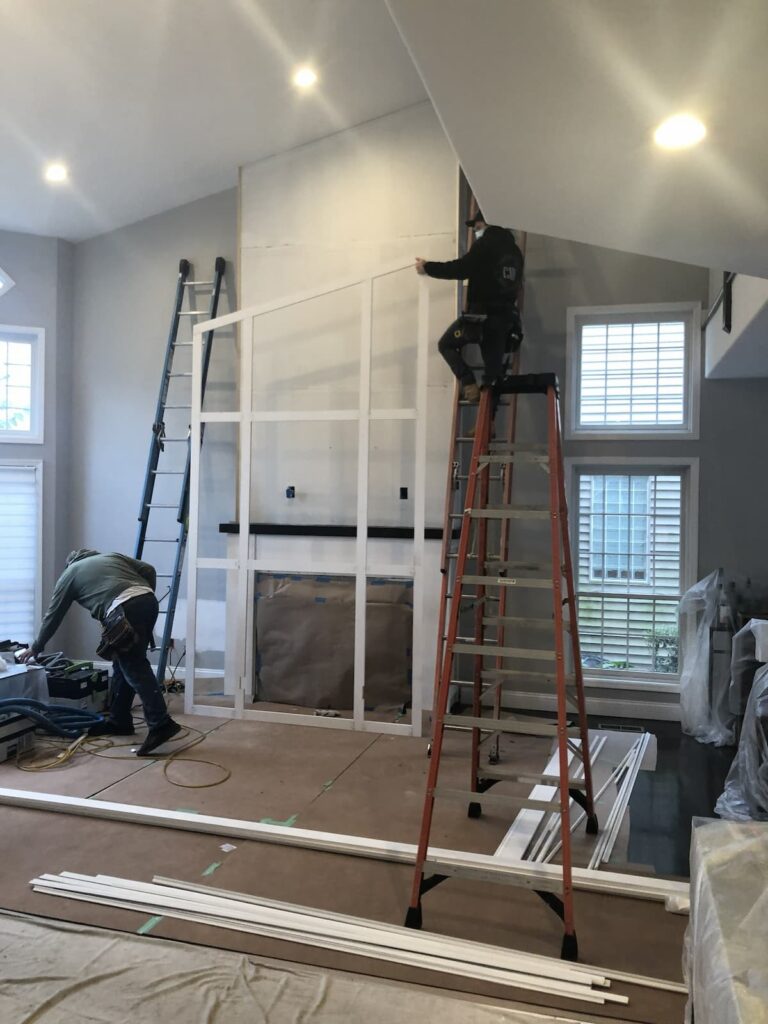
The build technique here is the highlight of the project: one-piece fabrication. Rather than installing individual pieces of trim and hoping the joints look clean on the wall, we built the entire wainscoting frame flat in the shop. The frame was assembled from 3-inch wide by 12-foot high pieces of poplar, jointed together to create one continuous frame — and that one-piece frame was then carried into the room and lifted into place against the vaulted-ceiling wall.
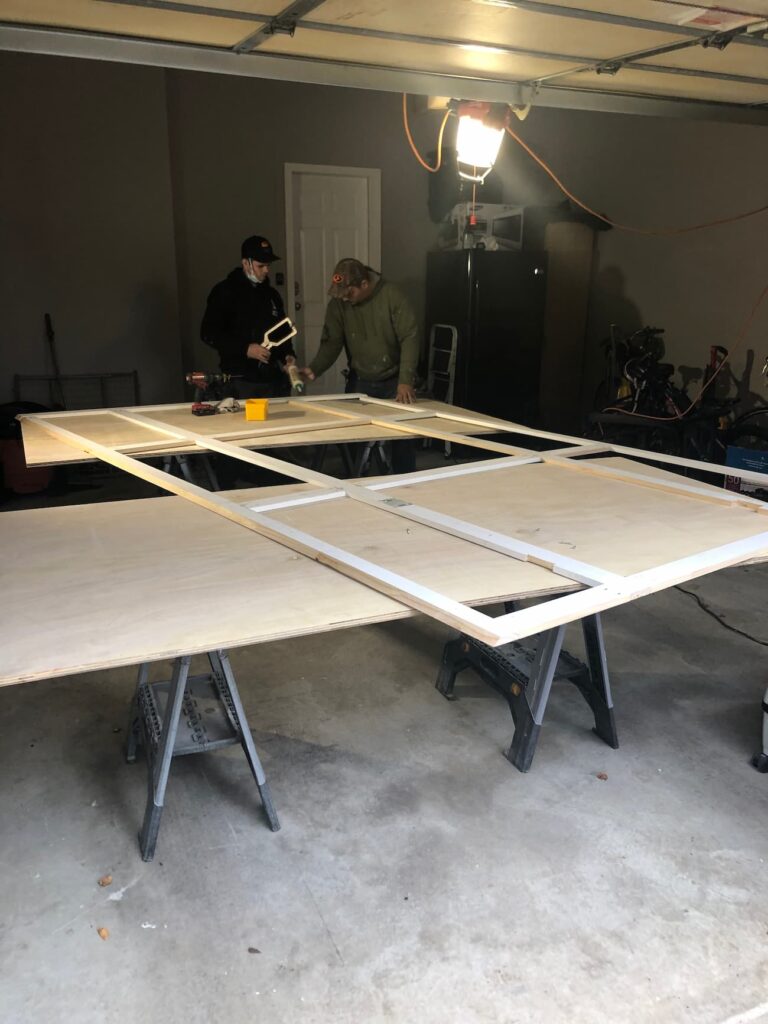
That approach delivers a result you can’t get from on-wall installation — every joint is tight, every line is straight, and the symmetry of the design is maintained across the full height of the wall.
The Surround and the Tile
The fireplace surround — the legs and header framing the firebox opening — was built from the same solid poplar as the wainscoting, with the same finish. Treating the entire painted millwork as one cohesive system means the fireplace doesn’t read as a separate element pasted onto a wainscoted wall. It reads as one continuous architectural composition.
The firebox itself was inset with white marble tile sized to the firebox dimensions — required to meet non-combustible building code clearance from the heat source. The marble’s coolness against the warm white painted millwork gives the fireplace a clean, classical look that complements the white oak mantel above it.
The fireplace itself is a 48-inch Majestic gas insert — modern, clean-burning, and properly sized for the opening. The Town of Oyster Bay permit on this job was pulled by a licensed plumber for the gas line work; the millwork itself is permit-exempt.
The Finish: Sherwin-Williams Kem Aqua System
After assembly, every surface of the wainscoting and surround was sanded using Festool dust extraction equipment — a clean prep that produces a substrate the finish can actually grip. Without proper sanding and dust removal, even the best finish reveals every imperfection in the wood.
The finish system was Sherwin-Williams’ professional pre-cat lacquer line: Kem Aqua Primer followed by Sher-Wood Kem Aqua Plus White Pigmented Interior. Multiple coats, sprayed and sanded between, all done on-site with a portable spray booth. The Kem Aqua line is what high-end cabinet shops use because it produces a hard, durable, factory-grade finish that brush or roller application simply cannot match.
The homeowners called the finished result magazine-quality. That’s not the goal — the goal is just to do the work right. The magazine-quality outcome is what happens when the technique, the materials, and the prep all line up.
Built-Ins, Wainscoting, Mantels, and Architectural Trim
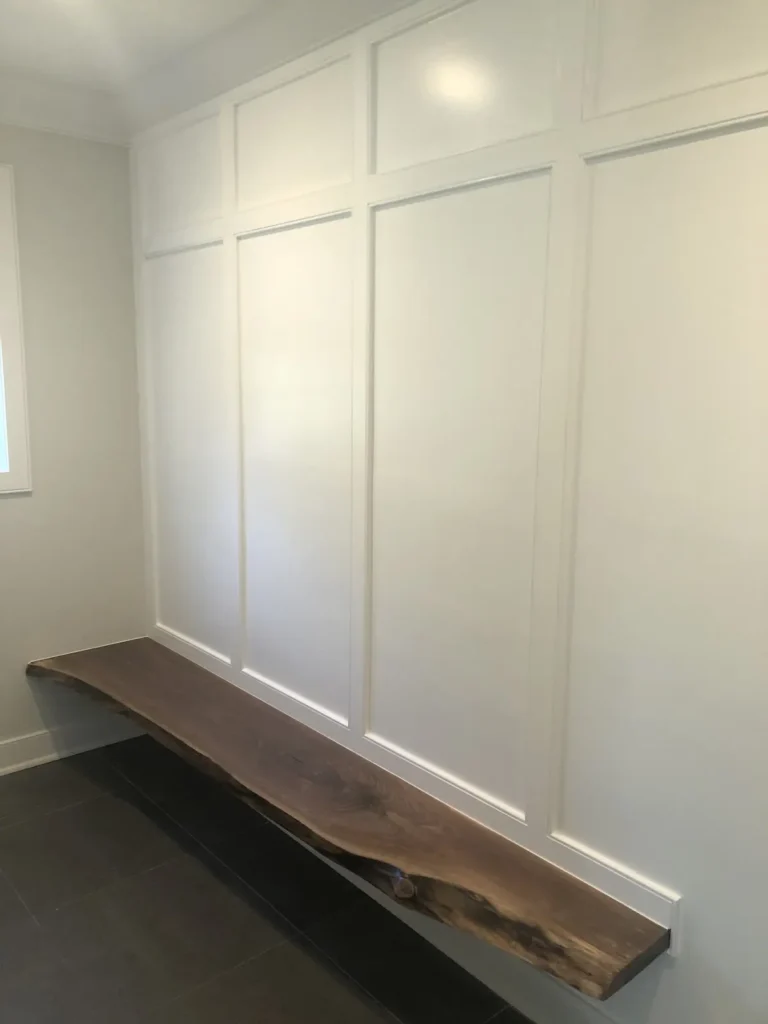
Custom millwork covers a wider range of work than most homeowners realize. It can be as small as a single mantel or as involved as a full wall system with cabinetry, paneling, and integrated fireplace details. What scope is right for your home depends on the room, the ceiling height, the existing trim, and how the space actually gets used day to day.
Built-ins are what turn a fireplace into a complete wall. Without them, you’re left with empty space or furniture that doesn’t quite fit. With them, the wall becomes balanced, functional, and intentional. Custom built-in bookcases and cabinets are designed around the fireplace opening, the ceiling height, and how the room is actually used. They add storage, but more importantly, they give the wall structure — something many standard Plainview homes were never built with.
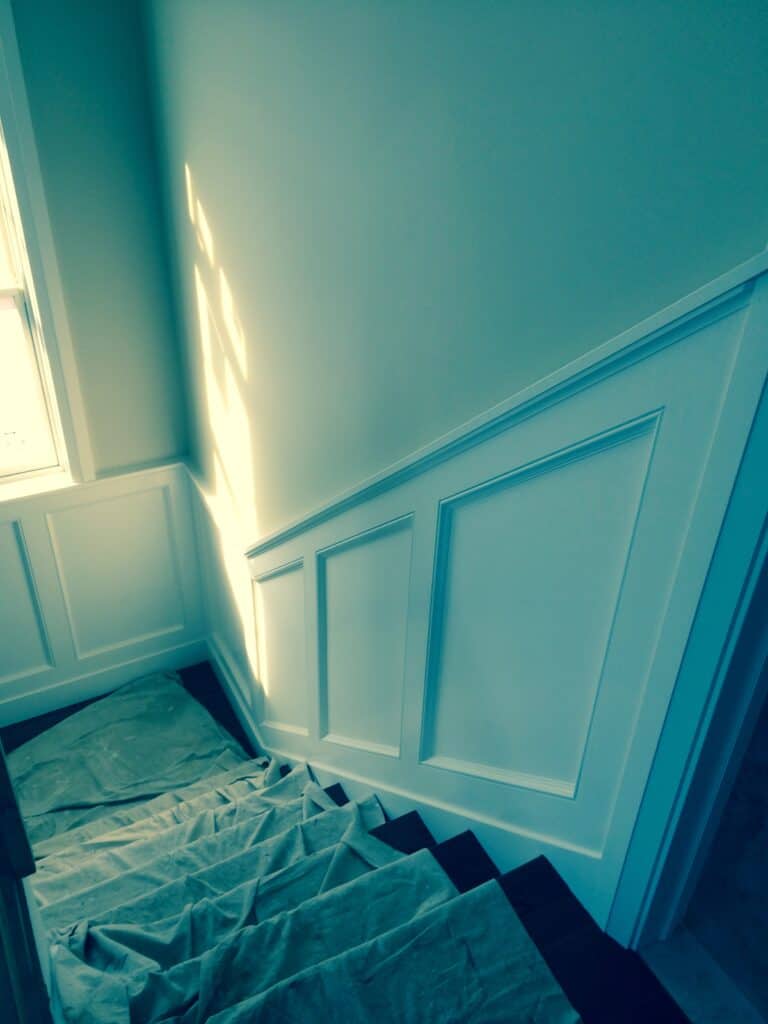
Wainscoting and panel molding add structure to flat walls. Dining rooms, entryways, stair halls, and fireplace walls all benefit from the rhythm and proportion that paneling brings — the kind of architectural depth drywall alone can’t deliver.
Mantels and fireplace surrounds are the trickiest pieces because they sit at the intersection of heat, tile, masonry, gas inserts, and finished wall surfaces. A mantel that’s too small looks weak. A surround that’s too bulky overwhelms the firebox. The proportions have to be right and the materials have to be selected for the application. A good fireplace wall is designed as one system — not three separate elements bolted together.
Coffered ceilings, beam work, and architectural trim are where millwork stops being a feature and becomes the architecture of the room itself. Done well, this kind of detail makes a standard Nassau County home feel custom-built. See our fireplace remodeling page for more examples of what a full wall system looks like when it’s done right.
Materials Used in Custom Millwork — Solid, MDF, and Hybrid
One of the first questions homeowners ask is: solid wood or MDF? The answer most contractors give is the answer that fits their margin — but the real answer is that both materials have their place, and a properly designed millwork project usually uses both.
Solid wood is the right choice for face frames, structural elements, and anything in a high-traffic area where the millwork is going to take physical contact. Solid wood holds fasteners better, takes repairs better, and ages better than any engineered substitute. For built-in cabinet frames, fireplace surrounds, mantels, and any element that bears load or sees daily wear, solid wood is the standard.
MDF has its place too. For panel work and crown moldings up at the ceiling — areas that don’t get touched, don’t bear load, and aren’t subjected to humidity swings — MDF is actually a better material in some ways. It absorbs less moisture than even properly kiln-dried poplar, and it’s not subject to the same expansion and contraction cycles. That stability matters for crown installed against a long ceiling line, where any wood movement would telegraph as gaps or cracks at the joints.
Hybrid construction — solid wood face frames with MDF panels — is how most high-end painted millwork is actually built. The face frames take the abuse and the fasteners; the panels stay flat and stable behind them. This is the construction approach for the wainscoting, built-ins, and most painted custom work in Nassau County.
Wood Species for Custom Millwork in Nassau County
Choosing the right species depends on whether the millwork is going to be painted or stained, the budget, and how the piece will be used. Here are the species we use most often in Nassau County:
Poplar is the workhorse of paint-grade millwork. It’s stable, much harder than primed pine, and holds fasteners and glue beautifully. The Plainview wainscoting and surround were built from solid poplar throughout. For painted built-ins, painted wainscoting, painted surrounds, and painted trim, poplar is the standard.
White oak is the species we reach for when the homeowner wants stained or oiled millwork with real visible grain — mantels, exposed beams, accent pieces. It’s hard, dimensionally stable, and takes finishes (especially penetrating oils like Rubio Monocoat) exceptionally well. The Plainview project’s mantel was built from milled-up white oak for exactly that reason.
Walnut is for the homeowner who wants a darker, more dramatic feature. It’s a premium species at a premium price, but for a feature mantel or a single accent built-in, the result is striking.
Maple works for both painted and stained applications. It’s harder and denser than poplar, which makes it a good choice for cabinet door frames or anywhere the millwork takes physical contact.
Paint-Grade vs. Stain-Grade Millwork — What’s the Difference?
Paint-grade and stain-grade millwork are not the same thing, and the decision has to be made before fabrication begins — not after.
Paint-grade millwork is exactly what it sounds like — built to be painted. It’s typically constructed from multiple pieces of wood joined together, sometimes using mixed lumber where the grain doesn’t need to match because paint will cover it. Paint-grade should not be stained because the joints, the species mix, and the underlying construction will all show through a stain.
Stain-grade millwork is built from solid lumber — typically all from the same species, often hand-selected for grain consistency. It’s designed for the wood itself to be the finish. Stain-grade construction is more expensive because the lumber selection is more demanding and the joinery has to be cleaner.
Trying to stain a paint-grade piece reveals every joint and species change. Trying to paint over stain-grade lumber wastes the money you spent on the premium grain selection. Pick the path before the lumber gets ordered, and the work matches the budget either way.
The Process: From Estimate to Final Coat
Custom millwork projects unfold in a specific sequence, and understanding that sequence helps homeowners know what to expect at each stage.
Step 1 — On-site assessment. Kevin walks the space, measures the wall, ceiling height, and any existing details that the new millwork needs to match or relate to. He listens to what the homeowner wants and identifies what’s actually possible for the room.
Step 2 — Design and material selection. Proportions are determined by the room — not by a catalog. Wood species is selected based on whether the piece will be painted or stained. Hardware is specified. The homeowner reviews and approves the design before any wood is purchased.
Step 3 — Lumber sourcing and acclimation. Quality lumber comes from real lumber yards, not big-box stores. Box-store millwork lumber is fast-grown, often chemically treated, and dimensionally unstable. After purchase, the lumber acclimates in the shop for several days before fabrication so it reaches equilibrium with the local humidity. Skipping acclimation is a leading cause of millwork that cracks, warps, or pulls apart after installation.
Step 4 — Shop fabrication. The components are cut, milled, joined, and assembled in the shop. Joinery is built using Festool Domino floating mortise-and-tenon joints and Kreg jig blind pocket fasteners. Glue bonds best to raw wood, so assembly happens before any primer or stain — never after.
Step 5 — On-site installation. The fabricated components are transported to the home and installed. For larger pieces — like the Plainview wainscoting frame — the installation is a two-person lift to set the assembly against the wall and secure it. Trim, transitions, and detail pieces are installed on-site after the main pieces are set.
Step 6 — Sanding and finishing. Every surface is sanded with Festool dust extraction equipment, then primed and finished. Painted millwork gets multiple coats of pre-cat lacquer, sprayed on with sanding between each coat. Stained millwork gets the appropriate stain or oil finish, hand-rubbed where required by the product.
Step 7 — Final walkthrough. Kevin walks the homeowner through the finished work, identifies any touch-up items, and addresses anything that needs attention before the project is closed out.
The same shop fabrication and finishing process applies whether the project is a fireplace wall like the one in Plainview, a built-in pantry as part of a kitchen remodel, or custom vanity and cabinetry work in a bathroom renovation. The technique doesn’t change room to room — only the design does.
6 Mistakes Homeowners Make with Custom Millwork
1. Buying lumber from a big-box store. Box-store dimensional lumber is fast-grown, sometimes chemically treated, and rarely dimensionally stable enough for fine millwork. Quality lumber comes from real lumber yards where the wood has been properly graded and dried. Saving 20% on the lumber and ending up with millwork that warps or cracks within a year is not actually saving money.
2. Skipping acclimation. Wood reaches equilibrium with the humidity of its surroundings. Lumber installed straight from the yard — with a different moisture content than the home it’s going into — will move after installation. That movement shows up as cracked joints, lifted panels, or gaps at the trim. A few days in the shop before fabrication solves this.
3. Using the wrong material for the job. Crown molding installed in solid poplar against a long ceiling line will move with humidity changes and telegraph that movement at the joints. MDF crown won’t. Conversely, MDF face frames on a built-in that takes daily wear will fail at the fasteners within years. Matching the material to the application matters.
4. Treating paint-grade and stain-grade as interchangeable. They’re not. Paint-grade construction uses multiple wood pieces joined together — sometimes mixed species — because paint covers everything. Trying to stain that same piece will reveal every joint and species variation. Decide whether the piece will be painted or stained before construction begins, not after.
5. Brush-finishing what should be sprayed. Painted custom millwork built to a high standard gets sprayed, not brushed. A brush leaves texture in the surface; a spray booth leaves a factory-smooth finish that reflects light evenly across the wall. The difference is visible from across the room. Asking your contractor whether they brush or spray is a fast way to gauge the quality of work you’re going to get.
6. Designing from a picture instead of from the room. A photo can give the project a direction, but it can’t substitute for measuring the actual wall. Pinterest and Instagram are full of beautiful millwork built into rooms that don’t share your ceiling height, your firebox dimensions, or your existing trim. Copying a photo without adapting the proportions to your space is how custom millwork ends up looking forced — too tall, too short, or visually competing with everything else in the room. The design has to come from the room, not from a screenshot.
Permits and Millwork in Plainview
Millwork itself — surrounds, built-ins, paneling — does not require permits. If the project involves gas lines, fireplace inserts, or structural changes, permits may be required through the Town of Oyster Bay. On the Plainview project, the gas line work for the fireplace insert was permitted through a licensed plumber; the millwork itself was permit-exempt. Kevin identifies what permits are needed during the estimate and advises on the full process. Most homeowners file the application themselves to save the cost — or we can connect you with an expediter who handles it for you.
Why Plainview Homeowners Choose Creatively Done Homes Improvements
Custom millwork is detail work. It’s not “install trim from a box.” The design has to fit the actual room. The materials have to be selected for the actual application. The joinery has to hold for decades, not until the next humidity cycle. And the finish has to look right under the natural light coming through the window — which is the lighting that exposes every shortcut.
Most contractors who advertise millwork are subbing it out, ordering pre-fab components, or installing what the box store carries. That’s not what we do. Kevin has 40+ years of hands-on remodeling and finish carpentry experience. He has run his own jobs since 1986, and Kevin, Matthew, and team handle every project directly — design, shop fabrication, on-site installation, and finish.
That direct involvement is the difference. When the team that designs the wall is the same team that mills the lumber, fabricates the frame, installs the assembly, and sprays the finish, the result has continuity from the first sketch to the final coat. Nothing gets handed off, nothing gets approximated, and nothing gets explained away.
Custom millwork is one of the few upgrades that changes how a room feels the moment you walk into it. A finished fireplace wall makes a living room feel complete. Built-ins make a space functional in a way furniture can’t. Wainscoting gives a plain room real architectural weight. A properly scaled mantel turns a basic firebox into the focal point of the home. For Plainview homeowners — and across Syosset, Jericho, Hicksville, Bethpage, and Woodbury — that kind of detail is expected at the price point of these homes. We build it the way it’s supposed to be built.
Frequently Asked Questions
How much does custom millwork cost in Plainview?
Smaller projects like mantels and paneling start around $3,000 to $8,000. Full wall systems with built-ins and fireplace integration typically range from $12,000 to $30,000+, depending on size, materials, and scope. Kevin provides a detailed written estimate after visiting your home — no guesses over the phone.
Can custom millwork be painted later?
Yes — paint-grade millwork can be repainted later without issue. The Plainview project was built from solid poplar — a stable, paintable hardwood that holds finishes far better than primed pine. Components were assembled with Festool Domino joinery and Kreg jig blind fasteners, with all glue bonds made on raw wood before any primer was applied. That construction sequence is what allows the finish to be refreshed years later without joints failing or paint lifting.
How long does a custom millwork project take in Plainview?
Most projects run 2 to 6 weeks from start to finish, depending on size and scope. Shop fabrication runs 1 to 3 weeks. On-site installation takes 2 to 5 days for a full wall system. Finishing — sanding, priming, multiple coats of pre-cat lacquer with sanding between — adds several more days because the spray-and-cure cycle can’t be rushed without sacrificing the final result.
How do you handle wood movement in built-ins?
Two things matter most: lumber quality and acclimation. Quality lumber from a real yard is dimensionally stable in a way that big-box dimensional stock — fast-grown, sometimes chemically impregnated — simply isn’t. Just as important is acclimating the lumber in the shop before fabrication so it reaches equilibrium with the working environment. Skip either step and the millwork will move after installation. Get both right and the work stays tight for decades.
What’s the difference between paint-grade and stain-grade millwork?
Paint-grade is exactly what it sounds like — millwork built to be painted. It’s typically multiple pieces of wood joined together, sometimes with species mixed in non-show areas, because paint covers everything. Paint-grade should not be stained because every joint and species change will show through. Stain-grade is built from solid lumber, often hand-selected for grain consistency, and designed for the wood itself to be the finish.
Do you use MDF or solid wood?
Both — and they both have their place. Solid wood is the right choice for face frames, structural elements, and millwork in high-traffic areas. MDF works well for panel work and crown moldings up at the ceiling because it absorbs less moisture and isn’t subject to the same expansion and contraction as poplar or other solid lumber. The right material for the job depends on where the piece sits, how it’s used, and how it’s finished.
Can custom millwork match my home’s existing trim?
Yes — anything can be fabricated, but matching existing trim profiles often requires custom milling, which adds to the cost. Kevin assesses the existing trim during the estimate and advises on whether matching it is straightforward or requires custom knife grinds at the mill. For most stock profile matches, custom millwork blends seamlessly with what’s already in the home. For unusual or historic profiles, the match is possible but the budget reflects the additional work.
Can built-ins be added to an existing fireplace wall?
Yes. In most cases, built-ins can be designed around an existing fireplace as long as there is enough wall space. The design is adjusted to match the opening and proportions of the room. Kevin assesses the wall during the estimate and tells you exactly what’s possible for your specific space.
Is custom millwork worth it?
Yes — because it affects how the entire room looks and functions. It’s one of the few upgrades that adds both visual impact and usable space at the same time. For Nassau County homeowners in Syosset, Jericho, and the Oyster Bay area especially, millwork is expected at the price point of these homes.
Do you serve Plainview and surrounding areas?
Yes — Creatively Done Homes Improvements Inc. serves Plainview, Syosset, Jericho, Hicksville, Bethpage, Woodbury, and all of Nassau County. Plainview, Syosset, Jericho, Hicksville, Bethpage, and Woodbury all fall under Town of Oyster Bay jurisdiction, which means consistent permit process and inspection standards across these towns. Most homes in this area are post-war split-levels, ranches, and Capes that respond exceptionally well to custom millwork upgrades.
Get Started on Your Plainview Custom Millwork Project
Kevin, Matthew, and team handle every custom millwork project directly — design, fabrication, installation, and finish. Whether you’re in Plainview, Syosset, Jericho, Hicksville, or anywhere across Nassau County, call 516-470-1961, request your free estimate, or see finished work in our project gallery.
