

Load Bearing Wall Removal Nassau County | 2026 Cost Guide
If you own a Cape Cod, ranch, or split-level in Nassau County, there’s a wall in your house that’s driving you crazy. It’s the one between your kitchen and living room — the one that makes your 1,400-square-foot home feel like 800. Every homeowner we talk to in Hicksville, Plainview, and Bethpage asks the same question: Can we take that wall out?
We just finished a project on Meadow Street in Garden City — removed the load-bearing wall between the kitchen and living room, installed an LVL header, and opened up the entire first floor. The homeowner wanted an island where the wall used to be. When we were done, she stood in the new kitchen and said, “I can finally see my kids in the living room while I’m cooking.” That’s why people do this.

The answer is almost always yes. But the wall between your kitchen and living room is almost always load-bearing — and removing it wrong can crack your foundation, sag your second floor, or collapse your roof. This guide covers everything Nassau County homeowners need to know about load-bearing wall removal — from identifying the wall, to choosing the right beam, to understanding permits, timelines, and real costs.
What Is a Load-Bearing Wall and Why Does It Matter?
A load-bearing wall carries the weight of everything above it — the second floor, the attic, and the roof — and transfers that weight down through the framing to the foundation. Remove it without replacing that support, and you’re removing the structural skeleton of your home.
A non-load-bearing wall (also called a partition wall) just divides space. It carries no weight. You can remove a partition wall with a reciprocating saw and a weekend. A load-bearing wall requires engineering, permits, temporary support walls, a properly sized beam, and a contractor who understands load paths.
In Nassau County’s post-war housing stock — the Cape Cods built in the late 1940s, the ranches and split-levels from the 1950s and 1960s — the wall between the kitchen and living room is load-bearing roughly 90% of the time. The original builders used that center wall as the main structural spine of the house.
How to Tell If Your Wall Is Load-Bearing
There are clues, but none of them are definitive without professional assessment. Here’s what Kevin looks for during a free in-home estimate:
Check the basement or crawlspace. If a beam, column, or foundation wall runs directly below the wall in question, it’s almost certainly load-bearing. That wall is part of a continuous load path from roof to foundation.
Check the attic. If ceiling joists splice (overlap) directly above the wall, the wall is supporting the junction of those joists. This is extremely common in Hicksville and Plainview ranches where the original 2×8 ceiling joists weren’t long enough to span the full width of the house.
Check the wall’s direction. Walls that run perpendicular to the floor joists are more likely to be load-bearing. Walls running parallel to the joists are more likely to be partition walls — but there are exceptions.
Check the wall’s position. A wall near the center of the house, running the length of the house, is almost always structural. The exterior walls are always load-bearing.
The only way to know for certain is to have a licensed professional engineer evaluate the wall and calculate the loads. We coordinate this on every structural project — the engineer’s stamp is required for the building permit.
LVL Beams vs. Steel I-Beams: What Goes in After the Wall Comes Out
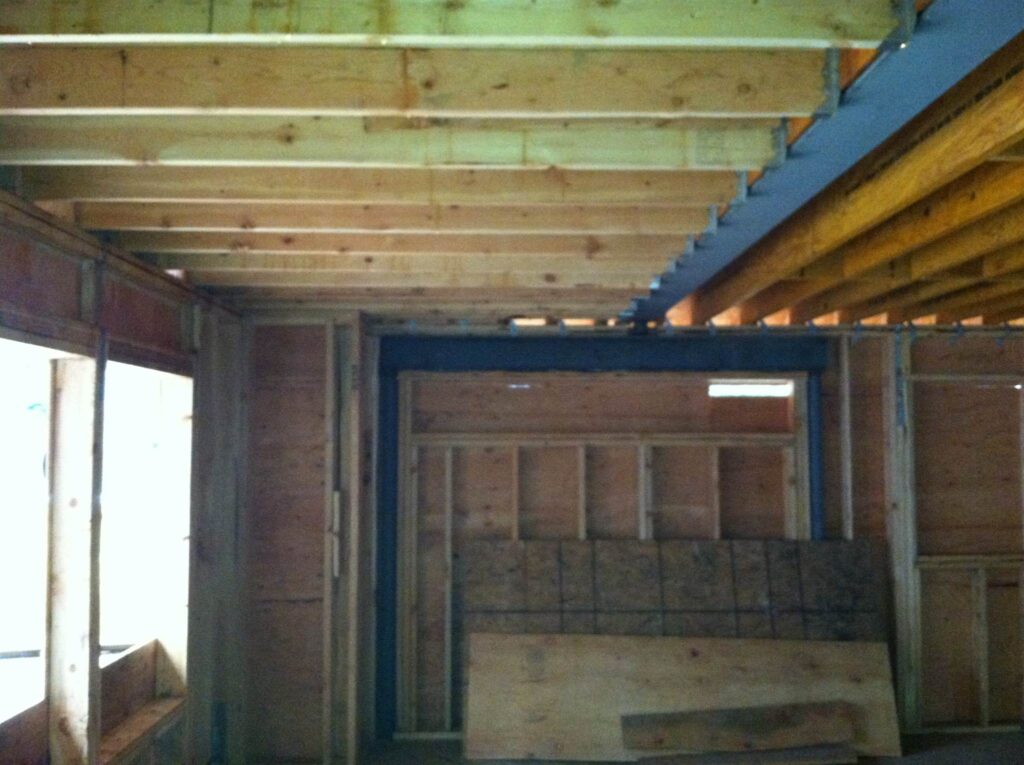
When a load-bearing wall is removed, something has to replace it. That something is a beam — and the two most common options for residential work in Nassau County are LVL (Laminated Veneer Lumber) beams and steel I-beams.
LVL Beams
LVL is engineered wood — layers of veneer bonded together under pressure. It’s stronger than solid lumber, doesn’t warp or twist, and is lighter than steel. For most Nassau County residential wall removals with spans under 18 feet, LVL is the right choice.
We typically use double or triple 11-7/8″ LVL beams for kitchen-to-living-room openings. The engineer sizes the beam based on the span, the tributary load (how much weight the beam has to carry), and whether there’s a second floor above. A 14-foot span in a single-story Plainview ranch requires a different beam than a 14-foot span in a two-story Bethpage colonial.
LVL beams can be concealed inside the ceiling framing for a clean, flush look — no visible beam. This is the finish most of our clients want, and it’s one of the details that separates a professional structural renovation from a hack job.
Steel I-Beams
Steel is necessary when the span exceeds what LVL can handle — typically anything over 20 feet — or when the load from above is exceptionally heavy (like supporting a second floor bathroom with a cast iron tub). Steel is also the choice for home additions where we’re opening up an entire exterior wall.
But steel isn’t always about new openings. On a job on Kingsbury Road, we found a wood girder in the basement that was severely compromised by termite damage — the beam that was holding up the first floor was half-eaten. We installed a steel flitch plate to re-support the damaged girder and restore the structural integrity of the home. That’s a repair you don’t find on a punch list — you find it when a trained eye looks at the framing and knows what to look for.
Steel beams are heavier, more expensive, and require more labor to install. Kevin has 40+ years of hands-on experience setting steel I-beams — including beams that required crane lifts for major home extensions. We’ve done it on projects from Syosset to Oyster Bay.
The engineer determines which material is appropriate. We don’t guess — the beam type, size, and connection details are all specified in the stamped engineering drawings that the Town of Oyster Bay or Town of Hempstead building department requires before issuing a permit.
The Permit Process in Nassau County
Removing a load-bearing wall in Nassau County always requires a building permit. No exceptions. Here’s the process:
Step 1 — Structural engineering. A licensed PE evaluates the wall, calculates the loads, and produces stamped drawings specifying the replacement beam, posts, connections, and any required foundation modifications.
Step 2 — Permit application. The engineer’s stamped drawings are submitted along with the permit application to either the Town of Oyster Bay or Town of Hempstead building department (depending on which jurisdiction your home falls under). Most Hicksville, Bethpage, Plainview, and Syosset homes are under the Town of Oyster Bay. Some Bethpage and Levittown homes are under Hempstead. Most homeowners file the application themselves — or we can connect you with an expediter who handles it for you.
Step 3 — Permit approval. Turnaround time varies. Straightforward wall removals typically take 2-4 weeks for approval. More complex projects with multiple structural changes may take longer.
Step 4 — Construction and inspections. The building department inspects the work at critical stages — typically after the temporary supports are in place and before the ceiling is closed up. This ensures the beam was installed exactly as the engineer specified.
Here’s something most homeowners don’t realize and most contractors learn the hard way: coordination with the building department is everything. You can’t just finish the work and then call for an inspection. You have to call ahead — before you’re ready — because the inspector’s schedule dictates your timeline. Case in point: all new work requires an insulation inspection before the drywall goes up. If you wait until the insulation is installed and then call, you’re sitting idle for days waiting for the inspector to show up. Kevin calls ahead and schedules proactively because 40+ years of working with the Town of Oyster Bay and Town of Hempstead means knowing how the process actually works — not just how the permit application says it works.
Kevin identifies what permits are needed during the estimate and advises on the full process — what drawings are required, which building department has jurisdiction, and what to expect at each inspection stage. Most homeowners file the application themselves to save the cost — or we can connect you with an expediter who handles the paperwork for you.
How a Load-Bearing Wall Removal Actually Works
Here’s what happens on the job site, step by step:
Day 1 — Temporary support walls. Before anything gets demolished, we build temporary support walls (called shoring) on both sides of the load-bearing wall. These carry the weight while the permanent beam is installed. This is the most critical step — skip it or do it wrong, and the ceiling sags immediately.
Day 1-2 — Demolition and utility relocation. The wall comes out. If there are electrical wires, plumbing pipes, or HVAC ducts inside the wall, they need to be rerouted before the wall is fully removed. Licensed electricians and plumbers handle these relocations under Kevin’s direct supervision.
And sometimes you find things nobody expected. On one job, Kevin opened up a wall and hundreds of thousands of carpenter ants poured out — dropped right on top of his head. The entire wall cavity was a colony. That’s the kind of thing you don’t find until the drywall comes off, and it’s the kind of thing a homeowner doing DIY demolition is not prepared to deal with. A professional knows how to assess the damage, bring in pest control, replace the compromised framing, and keep the project moving.
Day 2-3 — Beam installation. The LVL or steel beam is lifted into position and secured to bearing posts at each end. The posts transfer the load down to the foundation. In some cases, we need to reinforce the foundation beneath the posts with additional concrete footings.
Day 3-4 — Framing and concealment. The beam is framed into the ceiling so it disappears. The ceiling is patched, the floor transition between the two rooms is addressed, and the rough framing is completed.
Day 4-7 — Finishing. Drywall, taping, priming, painting, and final trim. When we’re done, you can’t tell a wall was ever there — just a wide-open space where a chopped-up floor plan used to be.
What It Costs in Nassau County (2026)
National averages you find online don’t reflect Nassau County pricing. Labor costs, permit fees, and engineering costs are all higher here than the national average. Here’s what to realistically expect in 2026:
Single-story ranch or Cape Cod, one wall removal with LVL beam (10-16 foot span): $8,000 to $15,000. This includes engineering, permits, temporary shoring, beam installation, framing, drywall, and paint. Does not include flooring transitions or kitchen/bathroom finish work.
Two-story home, first-floor wall removal supporting second floor (10-16 foot span): $12,000 to $22,000. The second floor adds significant load, often requiring a larger beam, stronger posts, and foundation reinforcement.
Steel I-beam installation for spans over 18 feet or heavy loads: $15,000 to $30,000+. Steel is more expensive to purchase, transport, and install. Crane lifts add to the cost.
Wall removal as part of a full kitchen remodel: $45,000 to $85,000+ for the full project. The wall removal is typically $8,000-$15,000 of that total, with the rest going to cabinetry, countertops, flooring, appliances, electrical, and plumbing.
These prices include everything — engineering, permits, all labor, materials, and finishing. We don’t give you a beam price and then surprise you with drywall, paint, and electrical bills later.
Why Nassau County’s Post-War Homes Need This More Than Most
The homes built in Hicksville, Plainview, Bethpage, Jericho, and Levittown between 1947 and 1965 were designed for a different era. Kitchens were small, closed-off workrooms. Living rooms were formal spaces separated by walls. The idea of a family gathering in an open kitchen-dining-living space simply didn’t exist when these homes were built.
Today, that closed floor plan is one of the most common complaints we hear from homeowners. The house has good bones — solid framing, a real foundation, a great location — but the layout doesn’t work for modern life. Opening up the main living area by removing one or two load-bearing walls transforms how the home functions, especially when the structural work is planned as part of a larger home renovation instead of treated as a standalone demo project.
This is what we specialize in. Kevin brings 40+ years of hands-on structural work — from ground-up new construction to setting steel beams for major home extensions. Kevin leads every structural renovation personally — from the initial assessment through the final coat of paint.
5 Mistakes Homeowners Make with Wall Removal
1. Assuming the wall isn’t load-bearing. “It’s just a short wall” or “my neighbor took his out and it was fine” are not engineering assessments. Every house is different. Get it evaluated. We had a homeowner ask us to just remove the lally column in the basement because it was “in the way.” He couldn’t understand why it was there. That column was carrying the entire first floor girder. Remove it, and the kitchen floor above sags six inches within a year. The things that look unnecessary are often the things holding your house up.
2. Hiring a handyman instead of a licensed contractor. A handyman can’t pull structural permits in Nassau County. And if the beam is sized wrong or the posts aren’t properly supported, the damage may not show up for months — but it will show up.
3. Skipping the permit. Unpermitted structural work is a time bomb. When you go to sell your home, the buyer’s inspector will flag the modification, the bank may refuse to lend, and you’ll be forced to open the ceiling to prove the beam meets code — or tear it out and start over.
4. Not planning for what’s inside the wall. That wall probably has electrical wires, possibly a plumbing vent stack, and maybe HVAC ducts. And sometimes worse — active pest infestations, old knob-and-tube wiring, or asbestos tape on heating ducts. Budget for rerouting utilities and addressing whatever you find. Surprises inside walls are the most common reason wall removal projects go over budget, and they’re the reason we always recommend a 10-15% contingency.
5. Forgetting the floor. When you remove a wall, the flooring underneath it is gone. If the two rooms had different flooring — carpet in the living room, vinyl in the kitchen — you now need a plan to make the floor continuous. This is an opportunity to install new flooring throughout, which most of our clients choose to do.
Frequently Asked Questions
Do I need a permit to remove a wall in my Nassau County home?
If the wall is load-bearing, yes — always. The Town of Oyster Bay and Town of Hempstead both require stamped engineering drawings and a building permit for any structural modification. Even some non-load-bearing wall removals require permits if electrical or plumbing work is involved. Kevin advises on what permits are needed and coordinates the engineering drawings — most homeowners handle the application themselves, or we can arrange an expediter.
How long does it take to remove a load-bearing wall?
The physical work takes 4-7 days for a straightforward single-wall removal including all finishing. Add 2-4 weeks for engineering and permit approval before work begins. If the wall removal is part of a larger home remodeling project, the wall comes out in the first week of demolition.
Can I remove a load-bearing wall myself?
Legally, no — not in Nassau County. Structural work requires a building permit, and permits require stamped engineering drawings from a licensed professional engineer. The building department also requires licensed contractors to perform the work. Beyond the legal issues, the safety risk is severe. An improperly supported wall removal can cause immediate structural failure.
What’s the difference between an LVL beam and a steel beam?
LVL (Laminated Veneer Lumber) is engineered wood — lighter, less expensive, and easier to conceal in the ceiling framing. It works for most residential spans under 18 feet. Steel I-beams are heavier and more expensive but necessary for longer spans (20+ feet) or heavy loads. The structural engineer determines which material is required based on the specific loads in your home.
Will removing a wall increase my home’s value?
In almost every case, yes. Open floor plans are consistently cited as one of the most desirable features by Nassau County homebuyers. A properly permitted wall removal with an engineered beam adds both functional value (more usable space) and market value (modern floor plan). The key word is “permitted” — unpermitted structural work devalues a home.
What does “open concept conversion” mean?
It means removing the walls that separate the kitchen, dining room, and living room to create one large, connected living space. In Nassau County’s post-war homes, this typically involves removing one or two load-bearing walls and replacing them with beams. It’s the single most requested renovation we perform — and it’s the one that transforms how a family uses their home.
Ready to Open Up Your Floor Plan?
At Creatively Done Homes Improvements Inc., Kevin leads every structural renovation personally — from the initial assessment through final paint. Whether you’re in Hicksville, Plainview, Bethpage, Jericho, or Syosset, we’ll evaluate your wall, coordinate the engineering, advise on permits, and deliver the open floor plan your home was always meant to have. When the wall removal is part of a larger scope, it belongs with whole-home remodeling.
Call us at (516) 470-1961 or request your free structural assessment. See examples of our completed projects in the project gallery, or review permits, costs, and local building department details in our Nassau County remodeling resources.


